
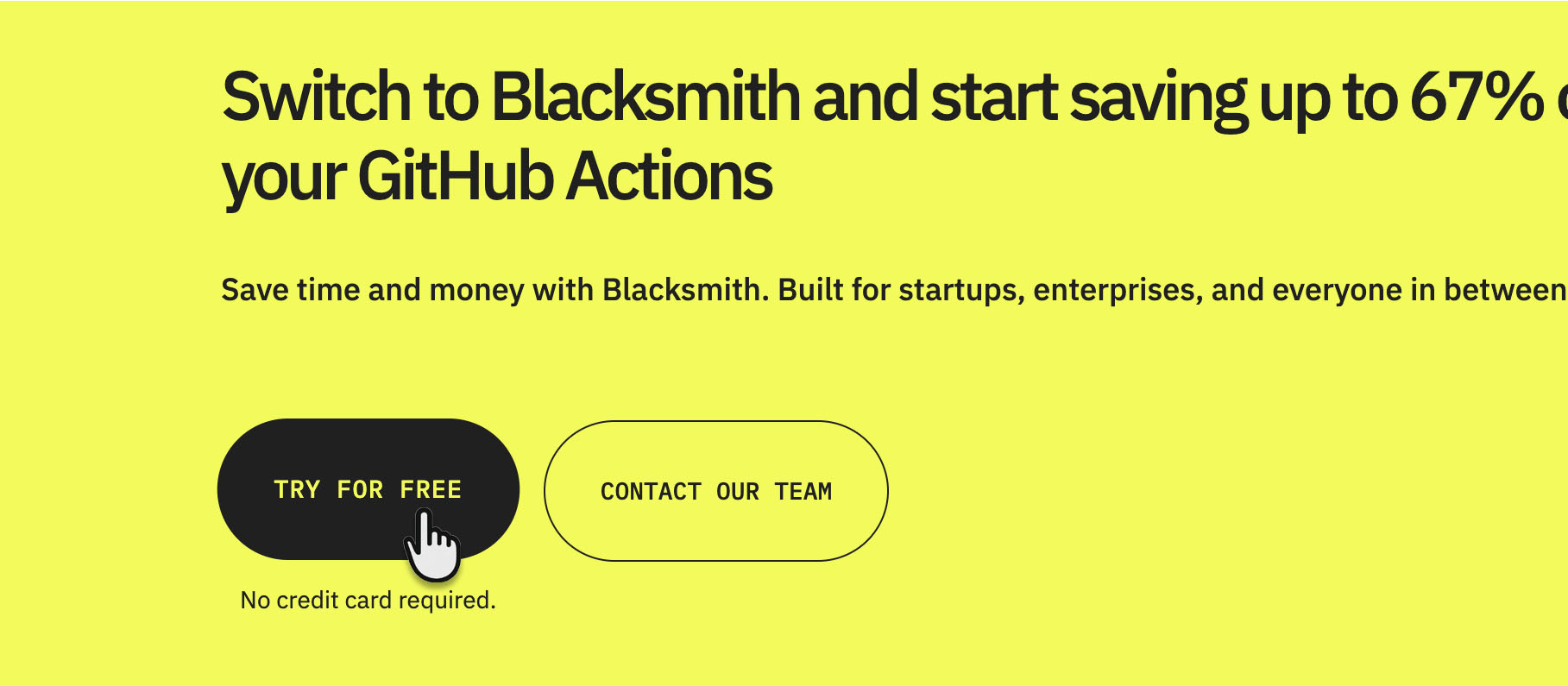
Like many developer teams, we’ve been getting fed up with GitHub Actions. As our PR throughput has gone up, it’s increasingly obvious that our CI actions are too slow and expensive.
While there are a lot of ways to mitigate this, we’d been encouraged to try Blacksmith.
Blacksmith is a YC startup that bills itself as a drop-in replacement for GitHub Actions, but cheaper and faster. So we gave it a try. Blacksmith imported our GitHub setup, and… it was faster! Maybe also cheaper, too, though that’s less clear when you’re on the free trial.
We got back to coding, as startups do, and before long we got an email about putting in a credit card:
We're writing to inform you that you've used up 80% of your free minutes for the forestwalklabs org this month. Please add a credit card on file to avoid disruptions to your service.
What we perhaps should have done at this point is stop and assess usage. But instead we did as early-stage startups tend to do, and we… continued coding until something stopped us.
A couple weeks later we got a “You’ve spent $500.60 on Blacksmith this month” message, which didn’t seem true since we were on the free trial still. Maybe that was what it would have cost if we weren’t on the trial? Anyhow, it was one of an embarrassingly large number of usage-warning emails in our inboxes, and this one neither had a credit card nor impacted production users.
A couple weeks later, we got in short succession another “Add a credit card to avoid disruptions” message, an invoice for $1081, then two days later an overdue notice:
This is a reminder from the Blacksmith finance team that some invoices are overdue.
The total amount due is $1,081.45.
Our contractually agreed payment terms require payment upon invoice generation.
Interesting!
Now typically, when you try a SaaS product for free without a credit card, and you hit the limit, you get cut off. Also known as “disruption to your service”. Instead, we were invoiced $1000, which was immediately overdue.
We asked for clarification, and Blacksmith support informed us that the previous warning of “disruption” was not that service would stop, but that it might be flagged for suspicious activity.
The "disruption" wording in our reminder email refers to account flagging for review such as suspicious activity and review for suspension. There is no wording stating automatic suspension of running jobs as we know how impactful this can be to customers. We don't cut workflows when the free tier is exceeded; they continue running and accrue usage at the published rates.
And, well… this is true! They didn’t explicitly say they’d stop running jobs if we hit the end of the free limit. They didn’t precisely say that “try for free” and “no credit card required” meant we wouldn’t incur thousands of dollars of charges. That was all just… convention.
This raises a few interesting questions. To wit:
1. Can they?
Can a SaaS vendor like Blacksmith send an invoice for a “try for free”, “no credit card” service that has exceeded its limit, and expect payment?
While amusingly as of June 8 Blacksmith’s terms implied that their right to bill you is contingent on you providing payment information, a SaaS app certainly could have terms that obligate users to pay for unexpected overage when on a free trial.
And let’s be clear: our agents run a lot of CI jobs, so we did expect to hit the limits of the free plan. We used the service and got value for it. So it’s not inherently dishonest, just surprising. My read is that they can do this.
2. Will customers be surprised?
What percentage of users would expect to get an invoice for CI overage on a “try for free”, “no credit card” service that has exceeded its limit?
I’m pretty sure this is low. Sub 5% maybe?
You can try asking a chatbot whether Blacksmith would likely cut you off vs. invoice for overage, and the averaged wisdom of the internet will argue pretty strongly that you’ll probably get cut off – even if you don’t mention the email warning you to add a credit card to prevent “disruption”. While of course this is evidence that chatbots can often be wrong, it’s also a hint that this policy is unusual.
Most users will expect the free limits on a SaaS service to be a hard cap, at least until you’ve put in payment information.
3. Should services do this?
You can imagine that letting free users go into overage, then sending them overdue invoices might make you more revenue than cutting them off. It’s not clear how much of this revenue you’d actually collect – surely your payables and write-offs would explode – but all other things being equal, it seems like it would increase revenue stats in the short term.
All things aren’t equal, of course. I think the clear answer is that this is a bad practice.
Letting credit-card-less users roll into accumulating overage creates headaches for the service provider and the customers, and mostly advantages abusive users (who never intend to pay, and now get more free runway). While this might juice short-term revenue stats, I’m highly skeptical the goodwill and abuse costs are less than the extra revenue.
I mean, maybe, if you think it’s unfathomable to cut off the free CI services you’ve provisioned to a trial user, you could give them warning – “Your CI services will be cut off in 72 hours if you don’t put in a credit card” or the like.
I can only speculate why Blacksmith instead chose to invoice in arrears. It could conceivably be sketchy growth hacking, a middle manager trying to hit a quarterly revenue stat. It could be technical debt between their billing systems and provisioning. And I suppose it could be the hot new trend among YC startups, trying to win share in a hot market.
But given Blacksmith’s naturally explosive growth amidst the tire fire that is GitHub in spring 2026, my money is on simple oversight. Perhaps a decision made under duress that they’ll soon figure out is not for the best.
Their support eventually said they “can look how to mitigate this confusion in the future,” so that’s something.
4. Should you use Blacksmith anyway?
This question is for us: will we keep using Blacksmith, despite them giving us an unpleasant surprise and a prickly support exchange?
Well, we tried switching back to GitHub Actions, and… yeah it still sucks. Blacksmith has grown explosively because it makes an increasingly frustrating bottleneck in the dev cycle faster.
In the end, we’re pragmatic. Our love of moving quickly exceeds any grudges about surprising billing policies. Blacksmith helps us build faster, and once we agreed to pay for the (actually useful) service, their support got friendlier. So… we’ll probably switch back.
But two tips for you, dear reader. First, if you build a SaaS service, be aware that most users will expect their free accounts to pause before accumulating overage, and sending them invoices is going to be poorly received by many.
And second: if you’re going to try Blacksmith, at least for the time being, maybe wind it down before you hit your trial limit.
Postscript: The folks at Blacksmith followed up on HN and with us directly due to this post.
Interestingly, they doubled down on their stance of not suspending service when people hit the free tier limit, but offered to credit us for the surprise overage, as well as share some changes they've been making to their pricing and overage copy so this should be less likely to surprise folks in the future.
While I'm still skeptical that "send invoices for free plan overage" is the right default SaaS pricing model, as long as nobody is surprised by it, it seems reasonable enough!